

STUDY | The Unfinished Farm Bill: First Reading of Proposed Senate Legislation by Jonathan Coppess
On June 23, 2026, Senator John Boozman (R-AR), chairman of the Senate Committee on Agriculture, Nutrition, and Forestry (ANF), released legislative text for the unfinished provisions of the traditional Farm Bill. Chairman Boozman is calling the legislation “Farm Bill 2.0” (Senate ANF, “Farm Bill 2.0” and Press Release, June 23, 2026). This article provides a first reading of the legislative text and some discussion about cuts to conservation proposed in it.
Background
The legislation being considered in Congress for food and agricultural policy is effectively the unfinished business of the traditional Farm Bill (Monke and Stubbs, December 18, 2025; farmdoc daily, April 30, 2026). The 119th Congress broke apart the traditional Farm Bill last year with the Reconciliation Farm Bill included in the One Big Beautiful Bill (OB3) Act of 2025 (P.L. 119-21). In that legislation, Congress cut food assistance in the Supplemental Nutrition Assistance Program (SNAP) by nearly $200 billion over ten fiscal years with a portion of those reductions used to offset the costs of substantially increasing support for farmers (CBO, July 21, 2025). With this, Congress broke the cardinal political rule of the traditional Farm Bill—i.e., that spending cuts for food assistance should not be used to fund spending increases for farm assistance and vice versa. The Reconciliation Farm Bill also left behind all other titles and programs, including the Conservation Reserve Program (CRP). Congress has not reauthorized the bulk of the traditional Farm Bill, including every program for rural economic development, research, many trade and food aid programs, forestry, energy, and the CRP. It is this unfinished Farm Bill business that Congress is now trying to address, belatedly and in the shortened legislative calendar of a difficult midterm election year. The House passed its version on April 30, 2026 (H.R. 7567; House.gov, April 29, 2026).
Chairman Boozman’s draft constitutes the first step in the Senate. the legislation will struggle to make it through the difficult legislative process within the campaign-shortened legislative calendar (including the August recess), and may require a lame duck session of Congress to complete as in 2018 (farmdoc daily, December 12, 2018). While Chairman Boozman’s draft is a critical first step, it should also be noted that it is long overdue. To recap, the 2018 Farm Bill technically expired in 2023, but the 118th Congress did not act. In 2024, the House Agriculture Committee reported reauthorization legislation that was not considered on the House floor. The Senate ANF Committee did not consider Farm Bill legislation in either year, former Chairman Debbie Stabenow (D-MI) and then ranking member Senator Boozman released competing Farm Bill texts after the election. The committee also did not formally markup legislation for the Reconciliation Farm Bill that was added to OB3 in 2025. If the Senate ANF Committee marks up the legislation recently introduced, it will be the first such formal debate of legislation since 2018 (Bridges, November 18, 2024; Baethge, November 18, 2024; Farm Policy News, November 19, 2024; Monke, December 26, 2024; see also, farmdoc daily, June 18, 2025; May 30, 2024; June 6, 2024; September 12, 2024; November 21, 2024).
Discussion
Chairman Boozman’s discussion draft weighs in at 902 pages. A first reading reveals that it is a mostly typical reauthorization of all the programs not included in the Reconciliation Farm Bill, such as those for rural development and research. For example, the very first section extends the suspension of permanent price support authority in the 1949 Agricultural Act to 2031. There are myriad changes to programs throughout the titles that appear to be standard and likely uncontroversial. This conclusion awaits a closer read and the public deliberation a markup provides.
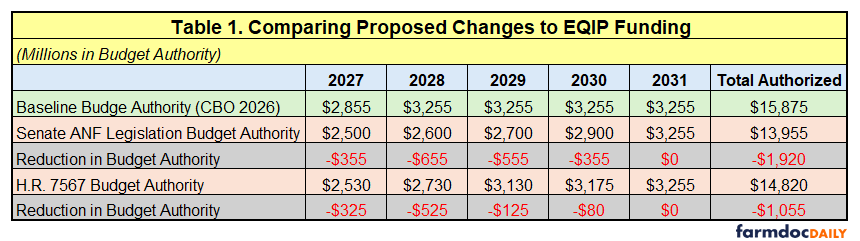
There is one rather puzzling exception, however. In the conservation title, Chairman Boozman’s draft includes a nearly $2 billion cut to the Environmental Quality Incentives Program (EQIP). While a CBO score was not available as of this writing, it is presumed that at least some of that reduction is used to offset the costs of other changes to conservation programs, including a new program, the Forest Conservation Easement Program. There are multiple reasons this raises concerns and may spark controversy.
Cutting EQIP funding breaks the commitment to the program made in the Reconciliation Farm Bill last year; Congress rescinded the additional funds it had provided to EQIP in the Inflation Reduction Act of 2022, adding them to the longer-term baseline budget authority. This was essentially a trade-off for conservation investments for farmers, trading the short-term increase of the Inflation Reduction Act for the long-term budget authority in the CBO baseline (farmdoc daily, September 11, 2025; August 15, 2024; October 10, 2024). For that trade-off to benefit farmers, Congress would have to avoid cutting the budget authority in the future. It now appears that both the Senate ANF Committee and the House Agriculture Committee are willing to go back on the earlier deal. Doing so also opens the door to further cuts to conservation by this or a future Congress. Table 1 details proposed cuts at issue, comparing the baseline budget authority with the Senate ANF revisions and the revisions that passed the House.
To read the full study, click here.